
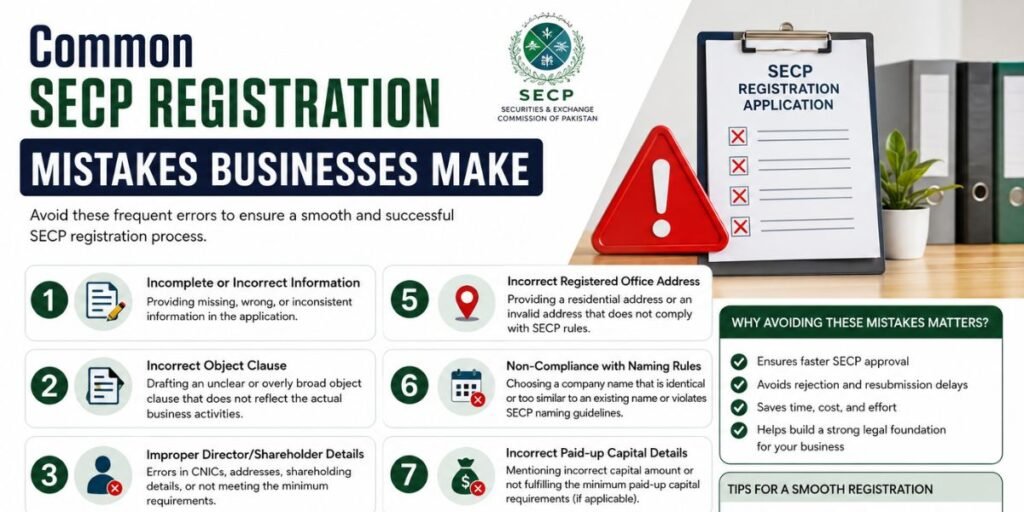
One of the most important actions for business owners and organizations operating in Pakistan is registering a company legally. However, during the registration process, a lot of companies, new businesses, and small business owners make mistakes that are avoidable that can result in late fees, fines, legal issues, or even application rejection.
These errors frequently result from inadequate records, poor planning, a lack of awareness of legal requirements, or dependency on false information. Businesses still face difficulties fulfilling registration and after-registration compliance demands, even though the standard has improved many processes through digital platforms and online services.
Business owners can prevent expensive mistakes and build a solid legal foundation for their companies by being aware of the most frequent registration errors. This article reviews the main errors that companies make when registering for SECP certification and offers advice on how to avoid them.
1. Selecting an Inappropriate Business Structure
Choosing an improper business structure without considering its financial and legal effects is one of the biggest errors made by business owners. Pakistan offers a variety of business structures, such as:
- Limited Partnership
- Public Limited Company
- Private Limited Company
- Single Member Company
- Sole Proprietorship
Without considering which structure best fits their business objectives, many new companies rush into registration.
Consequences
- Increased expenses for the agreement
- Inefficiencies in taxes
- Few opportunities for fundraising
- Risks of personal responsibility
How to avoid this
Before choosing a legal structure, carefully review your business model, development goals, ownership structure, and liability issues. Making the correct decision can be ensured by seeking expert legal or accounting guidance.
2. Choosing a Non-Compliant or Unavailable Company Name
Selecting a business name that is already reserved by another organization or that is against SECP naming standards is another common error. Before submitting applications, many business owners neglect to properly check for open positions because they are emotionally invested in a specific company name. Typical naming problems consist of:
- Using words that are forbidden
- Resemblance to current business names
- False language
- Use of illegal expressions related to the government
- Problems involving registered trademarks
Consequences
- Rejecting requests for name bookings
- Registration delays
- Extra filing fees
- Future issues over branding
How to avoid it
Before applying, carefully search for names and review the SECP naming guidelines. It’s also a good idea to have backup names ready in case the first choice isn’t available.
3. Providing Not Enough Records
One of the main reasons for registration delays is incorrect documentation. Companies regularly submit:
- Identification documents that are missing
- Unfinished forms
- Inaccurate signatures
- Scan copies that are unclear
- Absence of declarations
Business owners frequently ignore the significance of document accuracy and believe that small errors will be tolerated.
Consequences
- Rejecting an application
- Requests for more details
- Extended periods for approval
How to Control It
Before submitting, make a detailed list of all the necessary documents. Examine each document carefully to ensure that the information matches up with official records.
4. Giving Inaccurate Director Details
Directors of the company must have accurate information that is in line with official identifying documents.
Typical mistakes consist of:
- Names that are misspelled
- Inaccurate CNIC numbers
- Incorrect residential addresses
- Outdated contact details
- Incorrect personal information
During the registration review process, even small differences may raise problems with compliance.
Consequences
- Verification failures
- Delays in registration
- Complications with future compliance
How to Avoid It
Verify every detail before submitting by comparing all director information with official CNIC records.
5. Disregarding the Articles of Association Requirements
The company’s goals, governing structure, and operational guidelines are provided in the Memorandum of Association and Articles of Association.
Many companies just copy common templates without modifying them to fit their particular needs.
- Typical Issues
- Uncertain business goals
- Terms that go against each other
- Absence of governance clauses
- Inadequately written shareholder rights
Consequences
- Operational restrictions
- Investor worries
- Conflicts between shareholders in court
How to Avoid It
Make sure that the company’s legal documents accurately reflect business operations and future growth plans by carefully creating them.
6. A Limited Definition of Business Activities
When registering, many business owners give an unspecific or overly specific description of their operations.
Examples consist of:
- Using descriptions that are too general
- Leaving out scheduled future activities
- Including actions that are forbidden
- Giving information that is inconsistent
Consequences
- Regulatory problems
- Obtaining licenses is difficult.
- Limitations on operations in the future
How to Avoid It
Clearly define the business’s present and future operations while making sure that all applicable laws and industry rules are followed.
7. Making Use of Wrong Registered Office Details
An official registered office address is required for every registered business.
Companies frequently make errors like:
- Giving out temporary addresses
- Using inaccurate property information
- Not updating address changes
- Using addresses without permission
Consequences
- Absence of legal notices
- Violations of rules
- Risks associated with compliance
How to Avoid It
Make sure supporting documentation is available upon request and use a reliable, verifiable address.
8. Not Knowing the Requirements for Digital Signatures
Digital verification and electronic filing processes are necessary for SECP’s online registration system.
Many candidates find it difficult because they
- Do not understand digital signatures
- Make use of the wrong passwords
- Ignore the verification procedures
- Not protecting login information
Consequences
- Errors in filing
- Processing delays and security flaws
How to Avoid It
Understand the specifications of electronic filing systems and pay close attention to all verification processes. Some business owners wait to register their company until after they have begun operating. This frequently happens as a result of founders’ desire to test the market prior to starting operations.
Consequences
- Legal exposure
- Tax-related issues
- Banking issues
- Legal restrictions
How to Avoid It
Before signing big contracts, hiring staff, or taking sizable payments from clients, register the company.
10. Disregarding Industry-Specific License Conditions
Beyond SECP registration, some industries need other permits.
Examples consist of:
- Financial services
- Education in Healthcare
- Communications
- Production of food
Many companies mistakenly believe that formation is the only thing that allows them to function.
Consequences
- Regulation
- Interruption to business
- Financial fines
How to Avoid It
Before beginning operations, investigate all sector-specific licensing requirements.
Conclusion
To conclude, I would like to say that for businesses in Pakistan, SECP registration is a very important step, but many business owners make mistakes that can result in needless delays, legal issues, and expenses. Choosing the incorrect business structure, submitting incomplete paperwork, choosing unapproved company names, ignoring tax obligations, neglecting to keep records, and misunderstanding subsequent incorporation responsibilities are examples of common mistakes. Businesses can deal with the SECP registration process more effectively if they follow all the necessary things to follow.