
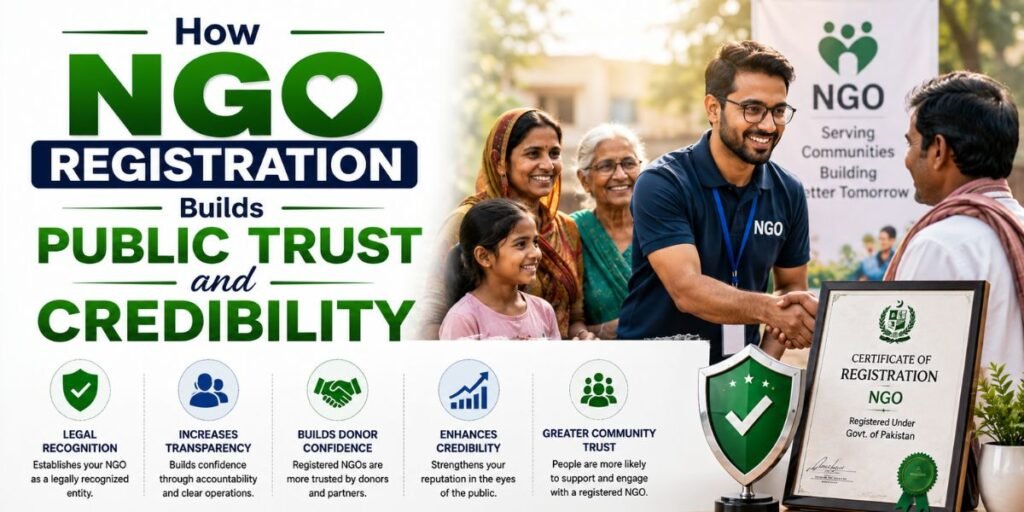
When it comes to dealing with social, economic, environmental, educational, and human rights concerns, non-governmental organizations (NGOs) are highly important. They aim to enhance the quality of life. However, an NGO’s performance depends not only on its goals and operations but also on the public’s trust and confidence. An NGO can perform many important tasks legally.
This article highlights the significance of NGO registration for healthy growth, financial accountability, legal protection, and long-term social benefit while outlining how it encourages public confidence and reliability.
To Understand NGO Registration
A charitable organization’s official legal approval by the appropriate government body is referred to as NGO registration. Typically, an organization must submit the following documents as part of the registration process:
- Bylaws or the Constitution itself
- Association Memorandum
- The organization’s goals
- Details about the founders and members of the governing body
- Address of the registered office
- Office holder identity documents
- Administrative and financial information
Following approval, the organization gets legal recognition and is able to carry out operations in accordance with national laws and regulations. A legal framework that defines the organization’s duties, financial commitments, governance structure, and reporting requirements is established through registration. This framework builds public trust and promotes responsible management.
Public Confidence Is Created by Legal Recognition
Legal recognition is one of the main ways that NGO registration promotes trust. An NGO is no longer an informal organization but a legally recognized organization once it is registered. The public has confidence in this legal status because the organization complies with government rules and follows the law.
Legally responsible organizations are typically trusted by the public since their registration shows that they:
- Possess identifiable leadership
- Have goals that are documented
- Stick to the law
- Regulators are able to keep an eye on them
- Must ad here to guidelines for reporting
Registration Proves the Validity of the Organization
Many people are unwilling to volunteer or make financial contributions to organizations that are not legally recognized. An NGO’s registration shows that it has a defined governance system and a valid objective. It confirms that the organization’s goals are social or charitable in nature rather than selfish profit. NGOs can separate themselves from fake organizations or fake charities that might abuse public donations by being reputable.
Verifying an NGO’s official registration increases people’s commitment to:
- Give money
- Take part in programs.
- Suggest the company
- Offer their time
- Discuss campaigns for fundraising
- Encourage long-term projects
Financial Disclosure enhances Trust
One of the best measures of an NGO’s reputable status is its financial openness. In accordance with legal requirements, registered NGOs must typically keep accurate financial records, create budgets, record spending, and submit financial reports. Responsible use of gifts and donations is demonstrated by transparent financial management.
Important financial procedures consist of:
- Keeping up with financial documentation
- Making annual financial statements
- When necessary, carrying out audits independently
- Keeping track of contributions from donors
- Monitoring project costs
- Financial performance reporting
Donors have more faith in the organization’s honesty when they are aware of how money is raised and used.
Responsibility Enhances Trustworthiness
NGOs that register are subject to legal and regulatory control, which holds them responsible for their deeds.
Accountability requires the company to answer to:
- Governmental bodies
- Board members, donors, and recipients
- Financing organizations
- The public at large
It is expected of registered NGOs to conduct themselves morally, keep correct records, and abide by the law. Stakeholders have confidence in this accountability that organizational decisions are documented and reviewed. Public trust naturally rises as responsibility does.
Enhances Donor Self-Confidence
Before donating, donors carefully review organizations. International organizations, corporations, charitable foundations, and individual donors typically favor funding registered organizations.
Donors feel confident about registration because:
- The NGO has legal recognition.
- Records of finances are kept.
- Leadership is recognizable.
- Monitoring is done on operations.
- There is legal compliance.
Before grant applications are considered, many funding agencies demand proof of registration. NGOs are able to access greater amounts and long-term funding opportunities as donor confidence increases.
Enhances Organizational Governance
Establishing trust is largely dependent on good governance. Generally, governing documents that specify the following are used by registered NGOs:
- Organizational goals
- Leadership duties
- Rules for membership
- Procedures for making decisions
- Controls over finances
- Methods for resolving conflicts
A structured governance framework promotes responsibility among business leaders and board members and prevents unjust decisions. Stakeholders are guaranteed by strong governance that the company is professionally run rather than run by self-serving individuals.
Encourages professional behavior
NGOs are encouraged to use professional leadership techniques through registration. Typically, professional associations have:
- Organizational structures that are clear
- Qualified staff
- Policies for human resources
- Systems for financial management
- Procedures for evaluation and observation
- Internal safeguards
Encourages a sustainable future
NGOs that are registered are more likely to get:
- Continual contributions, long-term loans
- Provide help
- Business partnerships
- Cooperation from the government
Instead of depending only on short-term donations
Stable support enables organizations to plan long-term projects.
Promotes Responsible Fundraising
Credibility is essential to fundraising. Generally speaking, registered NGOs are expected to raise money in a responsible manner by:
- Clearly outlining the campaign’s goals
- Giving out donation receipts
- Reporting the amount of money used
- Avoiding making false claims
- Respecting donor privacy
Regular contributions are encouraged and donor relationships are enhanced through responsible fundraising. When supporters witness proof that donations are handled appropriately, public trust increases.
Difficulties Unregistered NGOs Face
Organizations that operate without registration frequently face serious challenges, such as:
- Low donor confidence.
- Not being eligible for grants
- Having trouble opening bank accounts
- Decreased cooperation with the government
- Inadequate legal defense
- Limited opportunities for teamwork
- Inadequate public opinion
- Increased operational risks
The Best Ways to Preserve Public Trust
Following Registration
Trustworthiness is not ensured by registration alone. NGOs must consistently uphold public trust by acting responsibly.
Among the crucial best practices are:
- Regularly release yearly reports.
- Perform independent financial assessments.
- Adhere to moral fundraising procedures.
- Track the results of the project.
- Make sure the board has active oversight.
- Respect legal reporting obligations.
- Preserve the rights of beneficiaries.
- Improve governance procedures on a constant basis.
Conclusion
To conclude, I would like to say that an important initial step in establishing organizational credibility and public trust is NGO registration. they follow established legal frameworks and demonstrate a dedication to ethical and professional standards, they are typically seen as more trustworthy.
So it is very important for NGOs to be registered because when they are registered, they get more value and more fame in society because they get trust from the people and are able to maintain their name in the market.