
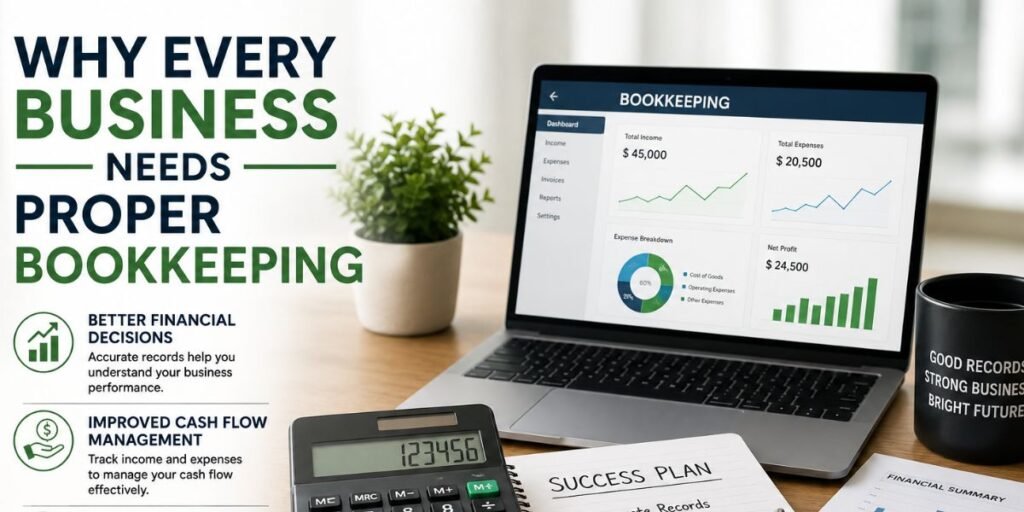
It takes more than simply providing excellent goods or services to be successful in the competitive business environment of today. No matter the size or industry, all businesses need to keep reliable financial records in order to achieve success. This is where bookkeeping is really important. A company’s money transactions are carefully recorded, arranged, and maintained through bookkeeping. It is the foundation of financial management and gives companies the data they need to make intelligent decisions.
This essay examines the necessity of correct accounting for all businesses and how it supports a stable environment, profitability, and long-term success.
Understanding Bookkeeping
All of a company’s financial transactions and other financial activities are recorded through bookkeeping. These documents are arranged into financial records, accounts, and diaries that give a comprehensive view of the company’s financial situation.
The following are the main purposes of bookkeeping:
- Keeping track of financial transactions
- Financial data arrangement
- Handling collections and accounts payment
- Monitoring earnings and expenses
- Making financial reports
- Encouraging paying taxes
- Helping with budgeting and planning
Gives a Clear Financial Overview
A clear and accurate picture of a company’s financial situation is one of the biggest advantages of bookkeeping. Business owners may find it difficult to figure out whether they are not keeping even, losing money, or making a profit in the absence of accurate data.
Accurate bookkeeping enables companies to:
- Track earnings and expenses
- Calculate profit
- Keep track of your wealth and expenses
- Examine the financial results
- Recognize patterns in a cash flow
Business owners can make well-informed decisions based on facts rather than assumption when they have access to reliable financial data. Additionally, it helps people recognize their financial advantages and disadvantages before they become major issues.
Helps in Effective Cash Flow Managing
A business’s cash flow is frequently its source of life. Poor cash flow management can cause even financially successful organizations to break down. In order to monitor and manage cash flow, bookkeeping is important.
By keeping correct records, companies can:
- Keep track of cash coming in and going out.
- Identify when there are financial shortages.
- Keep an eye on payments from clients.
- Control provider responsibilities
- Make plans for future expenses.
Business owners can better understand where their money is coming from and going when they maintain accurate books. They can make changes and stay clear of cash flow problems that can cause operations to be affected thanks to this visibility.
Encourages Better Making of Decisions
Every company choice has an impact on the bottom line. Accurate financial data is important whether a business is thinking about increasing operations, hiring new staff, buying equipment, or introducing a new product. Making smart choices is helped by the useful data that bookkeeping gives.
Financial reports can be used by business owners to:
- Examine the performance of the company
- Determine profitable goods or services
- Reduce wasteful spending
- Establish reasonable objectives
- Share resources wisely
Promotes Business Development
For most firms, growth is a common goal. However, careful financial management is necessary for growth. The data required to assess development prospects and determine whether the company is financially ready for expansion is provided by accurate bookkeeping.
Business owners require access to accurate financial information when discussing development efforts like opening a new location, introducing new goods, or entering new markets.
Businesses benefit from bookkeeping:
- Evaluate profitability
- Evaluate potential investments
- Keep an eye on growth patterns
- Control rising costs
- Obtain funding when required
Financial dealings are more complicated as a business expands. Strong bookkeeping processes guarantee long-term and well-organized growth.
Help in Securing Investment and Financing
Before giving cash, banks, borrowers, and investors frequently need complete financial data. Businesses have to show financial stability and honesty when applying for a loan or looking for investment. The financial records required to support these requests are provided by proper bookkeeping.
Usually, both investors and lenders examine:
- Statements of income
- Sheets of accounts
- Statements of money flow
- Trends in earnings
- Reports on costs
Investors and financiers are more likely to trust businesses that maintain accurate bookkeeping records. On the other hand, incorrect or incomplete records might make it harder to get funds and raise questions about financial management. Thus, accurate bookkeeping helps corporate expansion activities and enhances access to financing.
Increases Efficiency in Business
Improved customer service and higher profits are two benefits of efficient operations. By providing accurate financial data as required, proper bookkeeping promotes operational efficiency.
When records are well-planned, companies can:
- Process payments more quickly
- Properly handle payments
- Keep track of outstanding payments
- Keep an eye on supplier accounts
- Cut down on administrative delays
Efficiency is further increased by tools for automation and accounting software, which minimize errors and reduce physical data entry. Effective bookkeeping frees up business owners to put their attention less on management issues and more on expansion.
Helps with Performance Assessment
Continuous improvement requires measuring business performance. The information required to figure out important performance indicators like these are provided by bookkeeping.
- Growth in earnings
- Income
- Comparisons of expenses
- Performance of cash flow
- Investment return
Businesses can determine areas that need improvement and successful strategies by examining financial data. Organizations can stay competitive and adjust to shifting market conditions with the support of regular performance reviews.
It becomes challenging to determine whether the company is accomplishing its objectives in the absence of accurate bookkeeping.
Promotes Long-Term Sustainability
Strong financial bases are the backbone of sustainable businesses. By supplying the data required to effectively control resources and adjust to changing conditions, accurate bookkeeping promotes long-term success.
Companies that keep correct records are able to:
- Keep a close eye on your financial situation.
- React quickly to problems
- Determine chances for growth
- Increase sales
- Make confident decisions about strategy
On the other hand, poor bookkeeping can result in operational challenges, missed opportunities, and financial misunderstanding.
Last Words
In the end, I would like to say that maintaining accurate books is much more than just a standard administrative duty. It is an essential business function that helps long-term success, growth, compliance, financial management, and decision-making. A company’s financial situation may be clearly seen thanks to accurate bookkeeping, which also helps with managing cash flow, budgeting, tax preparation, and financial control.
Proper bookkeeping is necessary in an organization world that is becoming more difficult and challenging. Bookkeeping is one of the most important investments a company can make since it positions them for better efficiency, profits, and long-term sustainability.